


Pulse Natura
Wireless capacitive bioelectrochemical sensing for soil and water environments. Pulse Natura captures real-time signal patterns from living systems, helping operators understand biological response — not only environmental conditions.
Bright Habitat commercializes selected technologies emerging from the VizLore Labs Foundation R&D ecosystem — transforming sensing, AI, IoT, and distributed data-engineering outputs into products, pilots, partnerships, and revenue.
Many technologies are invented, validated in projects, and documented in reports. Far fewer become products that customers can pilot, buy, integrate, and scale. Bright Habitat exists to close that distance — building the commercial, technical, and operational runway between research output and market adoption.
We shape research outputs — datasets, algorithms, models, and prototypes — into intellectual property that can be carried into a commercial product line.
We turn validated IP into deployable hardware, software, and services — engineered for industrial environments, not only for demonstration.
We support pilots, integrations, sales conversations, and partnerships — turning early operator interest into recurring commercial activity.
Bright Habitat is the commercialization vehicle for selected technologies emerging from the VizLore Labs Foundation R&D ecosystem. VizLore Labs Foundation develops research outputs, technical know-how, datasets, algorithms, AI models, prototypes, and intellectual property through applied research and innovation projects. Bright Habitat takes commercially promising outputs forward — shaping them into deployable products, pilot projects, partnerships, and revenue-generating solutions.
Applied research and innovation projects creating datasets, algorithms, AI models, prototypes, and technical know-how with depth and scientific validation.
Commercially promising research outputs are translated into testable products — with technical validation, MVP definition, and pilot-readiness shaped around real industrial use cases.
The commercial product company. Bright Habitat builds, sells, and supports the deployable solutions that emerge from selected research outputs — running pilots, partnerships, and go-to-market.
Active solutions commercialized through Bright Habitat — concrete proof that the research-to-market model produces deployable industrial products.
Wireless capacitive bioelectrochemical sensing for soil and water environments. Pulse Natura captures real-time signal patterns from living systems, helping operators understand biological response — not only environmental conditions.
Real-time spectroscopic intelligence for food quality, authenticity, and safety. aiSpectra helps producers, distributors, and authorities detect risks at the point of decision instead of waiting for slow laboratory cycles.
The technical and commercial disciplines Bright Habitat applies to research-originated technologies as they move from lab outputs to industrial use.
Applied machine learning, signal interpretation, and analytical pipelines that turn raw sensor and operational data into decisions operators can act on.
Reliable ingestion, storage, and processing across edge, cloud, and on-premise systems — engineered for industrial uptime and growing data volumes.
Connected sensing hardware, wireless protocols, and remote monitoring — engineered for the field conditions where research-originated devices have to perform.
Functional proof-of-concepts that combine hardware, firmware, software, and UX — testable on real samples, in real environments, in front of real operators.
Customer discovery, pricing logic, and deployment-readiness assessments that translate research promise into a defensible revenue pathway.
Clean APIs, modular architectures, and connectors into ERP, traceability, and compliance systems — products that fit into industry, not products that ask industry to adapt.
A repeatable, end-to-end path that carries a selected research output through every step of becoming a commercial product.
Identify the industrial use case, the real customer need, and the adoption barriers that stand between research and revenue.
Translate selected research outputs into MVPs, demos, or pilot-ready products — engineered for industrial environments, not only for lab conditions.
Test technical performance, usability, customer value, and the deployment assumptions that will define commercial viability.
Connect the solution into existing workflows, APIs, data platforms, ERP, traceability, and compliance systems.
Support pilot programs, sales materials, partnerships, pricing logic, and the launch path that turns interest into recurring revenue.
The space between a validated research output and an industrial product is where most deep-tech stalls. Bright Habitat is built for that exact stretch.
Selected research outputs are reshaped into hardware, software, and services that customers can pilot, integrate, and pay for — built from the start for the field, not the conference stage.
Industrial adoption depends on more than one discipline working. We address device, data, intelligence, and go-to-market in parallel — so the product holds up end-to-end.
Operators ask different questions than reviewers. We translate scientific evidence into the integration, support, and compliance answers that procurement teams actually need.
Promising technology only matters if it reaches the market while the opportunity is still open. We work to shorten that distance — and to keep the path commercially honest.
Two locations, one commercialization mission — close to research partners in Europe and close to industrial markets in North America.
Talk to Bright Habitat about productization, pilot readiness, integration, and commercialization of sensing, AI, IoT, and data-engineering technologies.
Pulse Natura is a wireless capacitive biosensor platform that captures real-time bioelectrochemical signal patterns from soil and water environments — helping operators detect stress, change, and system response earlier than conventional condition monitoring alone.
Traditional sensors tell us what the environment looks like. Pulse Natura helps reveal how the biological system is reacting — continuously, wirelessly, and directly in the field.
Moisture, pH, EC, temperature, oxygen, weather — the inputs we already measure with conventional instruments.
Capacitive and bioelectrochemical signal patterns from the soil or water environment, captured continuously in-situ.
Earlier warnings, more grounded calibration, smarter agronomic and operational interventions.
Soil, irrigation, and water infrastructure are increasingly instrumented — but a critical layer is still missing. The biological response to those conditions is rarely measured in real time, and operators are left interpreting what the environment looks like instead of how the living system is actually reacting.
Moisture, EC and temperature describe the soil environment, but they don't reveal how the rhizosphere is responding to irrigation, fertilization, or stress.
Grab samples and laboratory analysis remain essential — but they leave long blind windows where biological or electrochemical change can develop unnoticed.
By the time crop stress or water quality issues become visible, the underlying response in the living system has already been unfolding for hours or days.
Agronomists, plant operators, and environmental teams are missing a continuous signal that bridges the gap between conditions data and laboratory truth.
Pulse Natura does not replace existing sensors. It complements them by capturing capacitive and bioelectrochemical signal patterns that reflect changes in the living environment — turning intermittent measurements into a continuous, in-situ signal stream.
A live capacitive / bioelectrochemical signal stream from soil or water, sampled and transmitted at low power.
BLE 5.x telemetry, ARM-class MCU, IP-rated enclosure, and an optional solar-assisted operation concept.
An additional layer for soil digital twins, irrigation logic, and water process monitoring — not a replacement for laboratory measurements.
In humans, measuring temperature tells us one condition. Taking medicine may lower the temperature — but the patient can still feel unwell. The condition changed; the body's response still matters. In agriculture and water systems, classical sensors measure conditions such as temperature, moisture, pH, EC, oxygen, and weather. Pulse Natura adds another layer: how the living system reacts to those conditions.
The same wireless capacitive biosensor node — configured for the medium it monitors. A unified hardware, telemetry, and analytics stack adapted to the operational realities of agriculture and water.
Pulse Natura helps agronomists see whether the soil system is responding positively or negatively to water, fertilization, heat, and other external conditions — adding a continuous biological signal layer alongside conventional moisture, EC, and weather data.
Pulse Natura can provide a continuous signal layer that helps operators detect biological or electrochemical changes before they become visible through periodic sampling alone — without replacing established laboratory or regulatory measurements.
A compact, low-power capacitive biosensor designed for in-situ deployment in soil and water environments. Engineered around an ARM-class MCU, a 24-bit ADC, and a graphite-based capacitive sensing element — fully wireless over BLE 5.x.
Captures capacitance and bioelectrochemical signal patterns directly at the soil or water interface.
Chemically robust electrode geometry, designed for durable deployment in real-world soil and water conditions.
Conditioning chain optimized for low-amplitude, low-frequency biosignals in noisy field environments.
High-resolution conversion to preserve subtle changes in capacitive and bioelectrochemical activity.
ARM Cortex-class microcontroller with duty-cycled sampling and BLE transmission for long deployment life.
Short-range, low-power wireless link to gateways, sensory boards, or mobile collectors.
Sealed housing designed for direct exposure to soil moisture, irrigation, and submerged water deployment.
From node → gateway → cloud ingest with storage, contextualization, and time-aligned signal handling.
Analytics and models surface trends, deviations, and response patterns for decision support.
Concept for energy-harvesting integration to extend deployment lifecycles in remote field locations.
Pulse Natura is a complete pilot-ready architecture: wireless field nodes, gateway aggregation, cloud-side processing, and an analytics layer that surfaces response patterns alongside conventional environmental data.
Capacitive and bioelectrochemical signal acquisition from soil or water through the graphite probe.
BLE 5.x wireless telemetry to a local gateway or sensory board, with low-power duty cycling.
Cloud pipeline cleans, stores, and contextualizes signal data alongside weather and condition feeds.
Analytics and AI models detect trends, deviations, and response patterns to support intervention decisions.
Wireless capacitive biosensor with graphite probe, ARM MCU, 24-bit ADC, BLE 5.x.
Local hub that aggregates BLE telemetry from multiple nodes and forwards it upstream.
Ingest, storage, signal cleaning, time alignment, and integration with external feeds.
Operator dashboard, API access, and analytics-driven recommendations.
A new sensing layer is needed — one that complements existing infrastructure and helps operators move from reactive measurement to earlier, response-informed decisions.
Crops, soils, and water bodies face more frequent thermal and hydrological extremes, raising the cost of late detection.
Water managers and agronomists increasingly need hours-ahead, not days-after, indicators to act effectively.
Laboratory analysis remains the gold standard for accuracy — but cannot deliver continuous operational signals.
Models of soil and water systems benefit from a live response signal to calibrate, validate, and stay current.
Pulse Natura is designed to sit alongside existing sensors and lab workflows — not to replace either.
Wireless biosensing is becoming feasible at field-deployable cost, opening a new operational data layer.
A structured pilot to deploy Pulse Natura nodes in a real operational setting, integrate them with existing instrumentation, and assess whether they add a meaningful, earlier, and more continuous response signal.
Understand the target environment, existing instrumentation, and the operational decisions that pilot data should support.
Install Pulse Natura wireless nodes at representative locations in fields, treatment plants, or water bodies.
Capture a continuous baseline of capacitive and bioelectrochemical signal patterns under normal operating conditions.
Align Pulse Natura signals with moisture, EC, weather, lab samples, and any other available reference data.
Operators see signal trends, anomalies, and response patterns alongside their existing data through a dedicated dashboard view.
A written report summarizing what Pulse Natura detected, how it compared to existing data, and where it adds operational value.
We are looking for pilot partners in agriculture, irrigation, soil monitoring, wastewater treatment, and environmental monitoring. Bring your operational context — we'll bring the wireless capacitive biosensor platform.
BrightHabitat's sensor-to-cloud platform detects contamination, fraud, and quality failures in real time — before they reach your customers.
of fruits and vegetables contain pesticide residues at point of sale
of global food crops are affected by mycotoxin contamination
food products is affected by fraud or adulteration along the supply chain
Traditional laboratory testing takes 24–72 hours. By the time results are back, contaminated product has already moved through the supply chain — sometimes all the way to consumers.
Spot-sampling a fraction of product gives false confidence. Contamination events are irregular and localized — a system that checks 2% of batches is blind to 98% of the supply.
Post-incident analysis dominates the industry. Risk is identified after something goes wrong — not before. Recalls, liability, and reputational damage are the inevitable result.
Sensor data, lab records, and compliance documents live in separate systems that don't communicate. Operators lack a unified view needed to identify systemic risk patterns early.
Spectroscopic analysis and on-device AI produce a definitive integrity verdict in real time — no lab, no waiting, no ambiguity.
Scan entire batches without sample destruction. High-throughput screening means meaningful coverage, not statistical guesswork.
Each scan feeds a growing intelligence layer. Patterns across sites, suppliers, and SKUs become visible — and actionable — at scale.
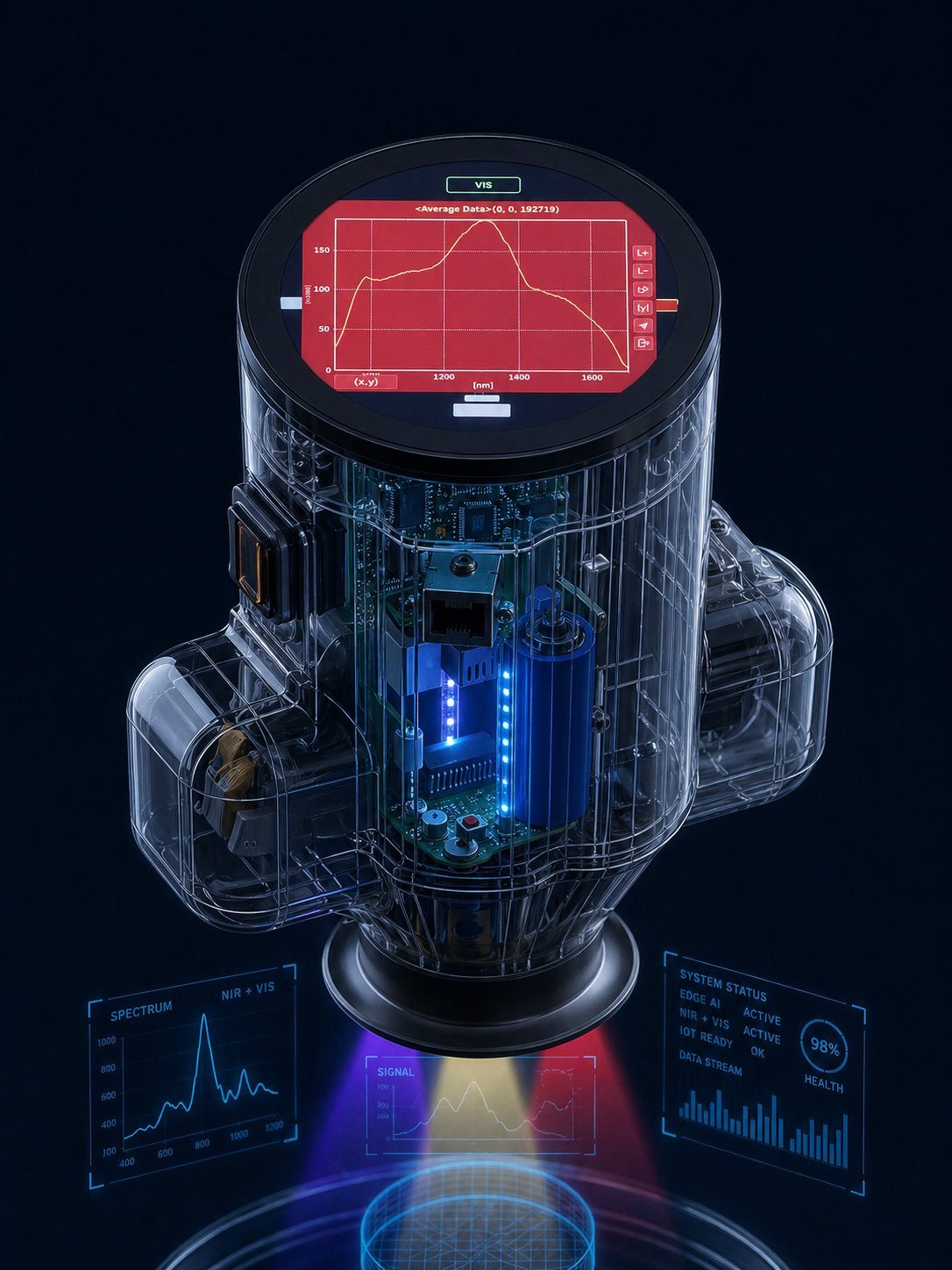
aiSpectra is a portable, multi-modal sensing device built for operational environments. It combines spectroscopy, machine vision, and edge AI into a single unit that delivers actionable integrity verdicts on the spot — without sending samples to a lab.
Mycotoxins, pesticides, heavy metals, microbial load — identified non-destructively with lab-grade precision.
Detect adulteration, origin fraud, and mislabeling at the point of receipt — before it enters your chain.
Moisture, fat, protein, freshness — continuous objective grading that replaces subjective visual inspection.
On-device models deliver pass / flag / fail verdicts instantly. Audit-ready and fully traceable.
Individual aiSpectra devices form an interconnected intelligence network. Every scan enriches a shared model — improving detection accuracy across the entire system without centralizing sensitive data.
Portable devices perform real-time, non-destructive scans at every critical control point across the supply chain.
On-device edge AI processes spectral data locally and generates immediate integrity verdicts — no round-trip latency.
Anonymized insights flow to the cloud platform, where multi-site risk patterns are identified automatically.
Federated learning continuously refines AI models using collective experience — raw data never leaves the source.
aiSpectra hardware + local AI inference at point-of-scan
Federated learning layer — model updates only, no raw data transfer
Centralized dashboard, analytics, alerting, and compliance reporting
Verify crop integrity and quality at harvest and storage entry. Detect contamination early to protect yield value before product leaves the farm gate.
Inspect incoming raw materials and monitor quality during processing. Automate acceptance/rejection decisions and maintain a continuous, auditable record.
Screen products at distribution centers and receiving docks. Reduce shrinkage from undetected spoilage and build verifiable transparency credentials.
Deploy city-wide food safety intelligence for proactive inspection programs. Replace infrequent spot audits with continuous, data-driven surveillance.
Sub-second verdicts replace 24–72 hour lab cycles. Decisions are made at the point of risk — not days later when the opportunity to act has passed.
Combining NIR, hyperspectral, and visual sensing gives aiSpectra broader detection capability than any single-modality device — with fewer false positives.
Raw data never leaves the source site. Federated learning means the collective network grows smarter without compromising business-sensitive information.
Open APIs connect aiSpectra data to ERP, traceability, and compliance systems. BrightHabitat enhances existing infrastructure rather than replacing it.
Faster than traditional lab testing for contamination verdicts
Batch coverage — full screening replaces statistical sampling
Reduction in food recall exposure for early-stage deployments
Raw data leaves the site — privacy-preserving by architecture
Catching contamination before it ships is exponentially cheaper than managing a recall. aiSpectra delivers the early warning layer your quality program is missing.
Every scan is logged, timestamped, and traceable. Automated reports meet the documentation requirements of major food safety standards.
Provide customers and regulators with cryptographically backed integrity certificates — turning food safety data into a competitive differentiator.
Book a technical demonstration with our team. We'll walk through your supply chain context and show you exactly how BrightHabitat integrates into your existing operations.